· by Michael Blair, Nashville's Tree Service
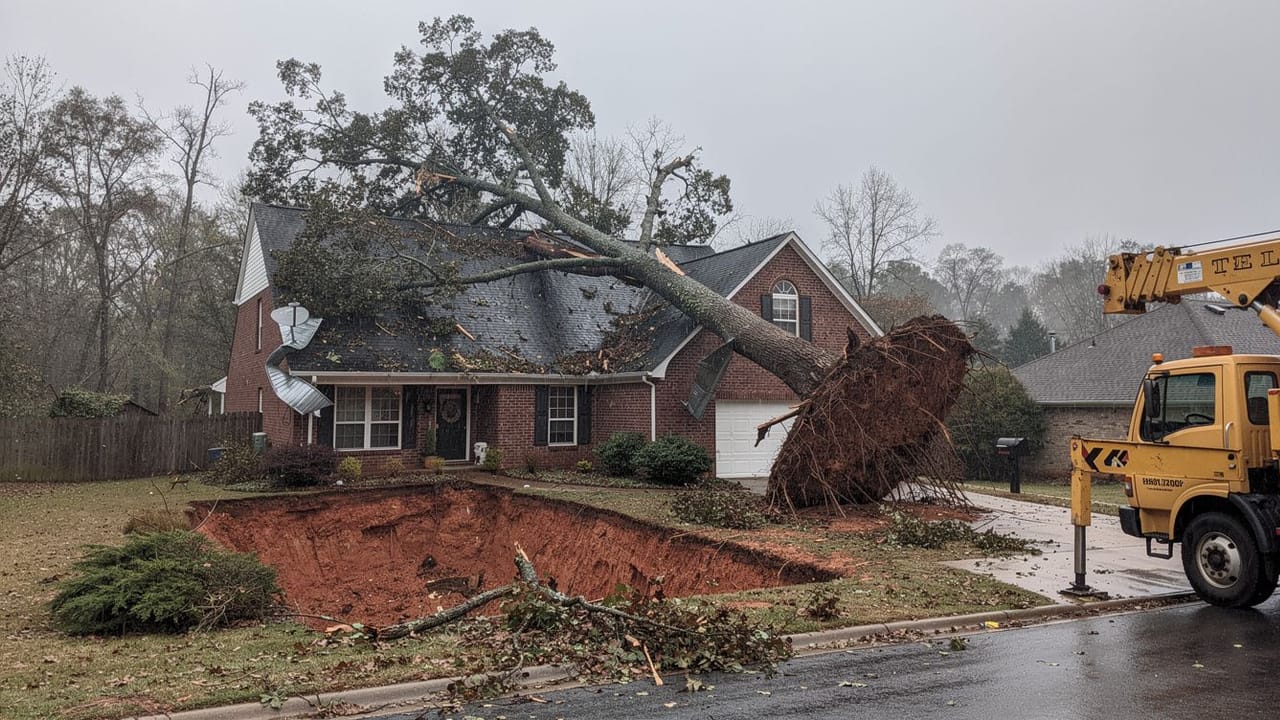
When a whole tree ends up lying across a house, the instinct is to get it off as fast as possible. That instinct is right about the timeline and wrong about the method. A trunk resting on rafters is a load the roof was never built to carry, and every limb in the crown is pinned, bent or springing against something. Cut the wrong piece first and the weight shifts onto framing that is already cracked. This is the order we follow on emergency tree calls in Nashville and the surrounding counties, written for the hours before a crew arrives, so the decisions you make in that window help rather than hurt. If the tree came from next door, who pays when a neighbor’s tree falls on your house covers that question; this post is about getting the tree off.
Look at the wires before you look at the roof
A tree big enough to reach the roof is usually big enough to have taken the service drop with it, the wire that runs from the pole to the weatherhead on your house. Walk out far enough to see that wire before anyone goes near the trunk. Nashville Electric Service’s home safety guide says to stay at least 35 feet from a downed line, treat every wire as energized, and call 9-1-1 for a hazardous condition. It also says plainly not to try pulling limbs or debris off power lines. A branch lying across a sagging service drop can look harmless and be anything but.
Even when the wire is still up, it often runs through the same crown that is now on the shingles. NES’s tree trimming page puts the tree near the service line on the homeowner, and says NES will disconnect service at no cost so a private tree company can remove it. On a tree resting on a roof we ask for that disconnect almost every time, because lowering wood past a live service line is the step where a manageable job turns into a torn mast.
If the weatherhead, mast or meter base was pulled loose, that repair belongs to a county-licensed electrician, and NES says it cannot safely reconnect the house until it is done. Book the electrician the same day you book us. The tree comes off first, the electrician repairs the mast, then NES restores power, and a delay in any one of those holds up the other two.
Call the insurer before the saw starts
The second call is to your insurance company, ideally before anything beyond emergency work begins. The Tennessee Department of Commerce and Insurance put its advice for storm claims in a 2021 release on filing claims and hiring contractors: file quickly, photograph or video each piece of damage, make the temporary repairs needed to stop more damage, and never have permanent repairs done until the insurer has inspected. The same release notes that removing a fallen tree is generally not covered unless the tree lands on and damages the home. A tree on the roof is the case that usually is covered, but your own policy’s wording decides it, so read it rather than assume.
Taking the tree off the house counts as the emergency step. Rebuilding the rafters, decking and shingles does not. In practice that means the tree comes off and the opening gets covered, and the structural repair waits for the adjuster. Photograph the trunk where it meets the roof, the inside of the attic if you can see daylight, and the root plate or broken stump in the yard before our crew touches anything. Our storm damage post goes into insurance coverage and storm crews in more general terms.
Why the tree comes off in pieces, and often by crane
The weight on a roof is not spread evenly. Most of it sits where the trunk crosses a ridge, a wall or an eave, and the crown is usually propped on its own limbs, some of them bent like springs. The first job is reading which limbs are holding the tree up and which are simply lying there. We take the loose wood first, working from the tips back toward the trunk, so that by the time we reach the pieces carrying the load, nothing else is going to drop or swing when they are cut.
The heavy sections are lifted rather than dropped. On many houses that means a crane: each section is rigged before it is cut, the crane takes its weight, and the piece is set down in the yard instead of rolling down the slope or punching through the decking it sits on. Where a crane cannot reach, we rig sections from the standing part of the tree or from another tree and lower them on ropes. Either way the goal is the same, to take weight off the framing in controlled steps rather than all at once. That rigging work is the core of our tree removal on tight Nashville lots, and on a roof it matters more.
We do not walk on a roof that has a trunk through it to make cuts, and we do not put a judgment on the structure. Once the tree is off, have a roofer or contractor look at the rafters and ceiling joists before anyone treats the room below as safe. If anything was sagging inside before we arrived, stay out of that room until the house has been checked.
Cover, cleanup and who you let do it
With the tree off, the opening gets dried in the same day: tarp, temporary decking where needed, whatever keeps the next rain out of the attic. That is the temporary repair the state’s guidance expects you to make. The wood in the yard is a separate question. Both NES pages say NES does not haul away storm debris, even when its own crews cut a tree to repair lines, so the trunk and brush are the property owner’s to deal with, and that should be spelled out in the estimate.
A tree on a house is exactly the situation the Tennessee Attorney General’s February 2026 alert on tree trimming and removal scams was written for. It warns against door-to-door offers and unsolicited calls or texts, against paying in full or in large part up front, and against cash. It asks homeowners to get several written estimates and a written contract, to check that the company is insured and that the policy actually covers tree work, and to confirm coverage with the insurer instead of trusting a promise that insurance will pay for everything. The alert notes that tree trimmers normally need a contractor’s license and that the storm-era suspension of that requirement ended March 7, 2026; look the company up at verify.tn.gov.
Work right at the service drop or near the street lines has its own rule. OSHA’s line-clearance tree trimming guidance keeps workers who are not qualified line-clearance tree trimmers at least 10 feet from overhead lines, and NES asks private arborists working inside 10 feet of an energized line to hold OSHA certification and get an NES assessment first. If a tree is still tangled in the lines along the street, that piece is a utility matter before it is ours. Where a removal needs Metro’s sign-off is covered in the rules for removing a tree in Davidson County.
- Stay 35 feet from any downed wire and call 9-1-1 if one is down
- Ask NES for the free service disconnect before the tree is moved
- Call the insurer and photograph everything before cutting starts
- Book a licensed electrician if the mast or meter base was pulled
- Get a written estimate that says who removes the wood
Sources
- Nashville Electric Service, Electrical Safety at Home — Stay at least 35 feet from downed lines, call 9-1-1, do not remove limbs from lines; licensed electrician for weatherhead, mast or meter base; owner responsible for storm debris.
- Nashville Electric Service, Tree Trimming — Homeowner responsible for trees near the service line; free disconnect for a private tree company; no storm debris removal; OSHA certification and NES assessment within 10 feet of an energized line.
- Tennessee Department of Commerce and Insurance, tips on filing claims and hiring contractors (2021) — File promptly, document damage, temporary repairs only until the insurer inspects; fallen tree removal generally covered only when it damages the home.
- Tennessee Attorney General, Watch Out for Tree Trimming and Removal Scams (Feb. 4, 2026) — Proof of insurance that covers tree work, no large up-front or cash payments, written estimates and contract, contractor license and verify.tn.gov, suspension ended March 7, 2026.
- OSHA, Line-Clearance Tree Trimming Operations — Workers who are not line-clearance tree trimmers keep at least 10 feet from overhead lines.