· by Michael Blair, Nashville's Tree Service
Search for tree removal in Davidson County and most of what comes back is about price. The question that should come first is whose rules the tree falls under. Metro Nashville has a code for trees on public land and a zoning rule for protected trees, Nashville Electric Service draws a line at the wire running to your house, and state law has something to say before anyone grinds a stump. None of it is hard once it is laid out, and sorting it out before the saw starts is what keeps a removal from turning into a citation, a downed wire or a cut gas line. This is how we work through it on every job for our tree removal service across Nashville and Davidson County.
What Metro’s tree code covers
Metro’s urban forestry chapter is about public trees. Under Metro Code 2.104.060, nobody may damage, destroy or remove a public tree without a tree removal permit from the urban forester, and a public tree is one on Metro property, which includes streets, alleys and any other public right-of-way. Where the trunk stands decides it. If the trunk is in the right-of-way, it is a public tree no matter whose yard the canopy shades, and it is not yours to cut. Where your lot ends is not always where the mowing stops, so check the plat or survey before assuming.
The zoning code reaches further. Metro Code 17.28.065 defines a protected tree as one at least six inches in diameter at breast height, or any tree two inches or larger in the public right-of-way, and section 17.40.440 says that unless a removal is exempt, no one may take down a retained, protected or heritage tree without a permit from the zoning administrator. We read the exemptions and did not find one that plainly covers an existing single-family lot, and the claims we have seen that homeowners are exempt came with no citation. Metro’s own Urban Forestry page ties its landscape plan requirement to developments other than single-family or duplex lots, which shows where the program’s attention usually sits, but that is not a blanket pass for every yard.
So we do not tell anyone they are exempt. Before a sizable tree comes down, call the urban forester at 615-862-6886 with the address and where the trunk stands, and confirm what applies to your lot. And if the tree is dead or dangerous on your side of the line, the same chapter, section 2.104.050, makes a hazard tree on private property the owner’s responsibility, and the urban forester can give an owner 30 days’ notice to deal with it.
Trees near the NES service line
Two kinds of wire run past most Nashville houses: the lines along the street, and the service line that drops from the pole to the weather head on your house. Nashville Electric Service’s tree trimming page is direct about the second one. NES does not remove trees near service lines; the homeowner is responsible for the removal. What NES will do is disconnect service at no cost so a private tree company can take the tree down.
That disconnect is worth scheduling. A limb lowered wrong across a live service line can tear the weather head off the siding or put the wire on the ground, and the call costs you nothing. When the service line runs through or under the canopy of a tree we are taking down, arranging the disconnect with NES at 615-695-7400 is part of planning the job, not a step we try to skip.
The lines along the street are a different matter. NES requires any arborist working within 10 feet of an energized power line to hold an OSHA Line Clearance Arborist Certification. If a tree leans toward the street lines, ask whoever you hire whether a certified line clearance arborist will be on the job, and if the answer is no, call NES before anyone climbs.
Checking the company before anyone climbs
Anyone with a saw and a truck can call themselves a tree service, so the checking falls to you. The ISA’s Find an Arborist directory lets you find and verify ISA-credentialed arborists. Listing there is voluntary, so a name missing from it proves nothing on its own, but a certification someone hands you should check out there.
TCIA accreditation is a check on the company rather than the climber. The Tree Care Industry Association calls it a third-party consumer confidence verification program; it lasts three years with yearly check-ups and requires the company to carry proper insurance. On a big removal over a roof, it is a fair thing to ask about.
The University of Arizona Cooperative Extension’s guide to hiring a tree expert adds two steps we agree with: confirm the insurance with the insurer itself instead of trusting a certificate handed across the tailgate, and put in writing that the work follows the ANSI tree care standards, naming A300 Part 1 for pruning and Z133 for safety.
- An ISA credential you looked up yourself
- Insurance confirmed by a call to the insurer
- ANSI A300 and Z133 named in the written agreement
- For work near the street lines, the OSHA line clearance certification
What the removal day looks like
Most of a removal in an established neighborhood happens before the first cut. We walk the drop zone, decide which limbs can fall free and which have to be roped down past the roof, the fence or the neighbor’s garage, and confirm the NES disconnect if the service line is involved. If the trunk sat anywhere near the right-of-way, the call to the urban forester was made days before.
Then the crown comes down in sections, top first, the wood either lowered on ropes or dropped onto open ground. Brush goes through the chipper as it comes down, and the trunk is cut into rounds you can keep for the firepit or have hauled off. On a tight lot the day runs longer than people expect, and the time goes into rigging rather than cutting; what drives the price of tree removal explains why that shows up in the estimate.
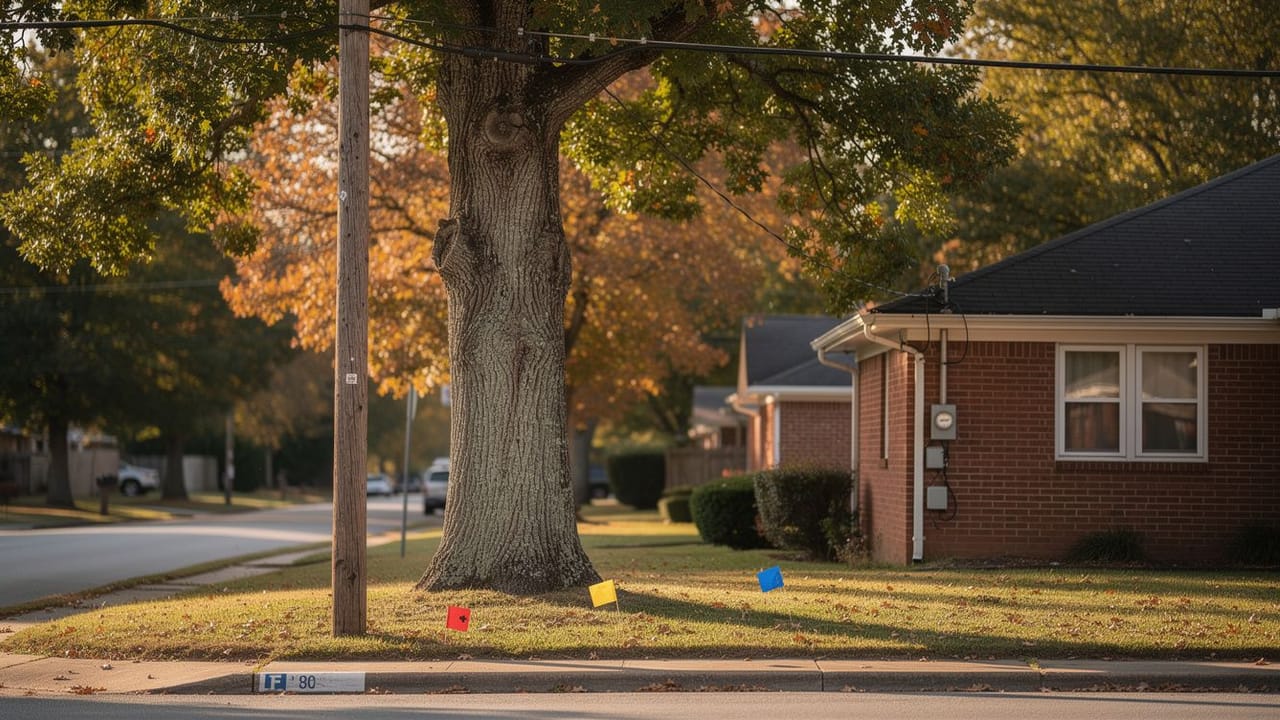
Grinding the stump comes last, and it is the step people forget involves digging. Tennessee 811’s FAQ explains that state law, TCA 65-31-101, requires at least three full business days’ notice before any type of excavation, naming hand digging, grading, augering and boring among others, and that an excavator hired for the work needs a ticket in its own name, valid for 15 calendar days. The law does not name stump grinding. We call anyway, because a grinder wheel goes below grade and buried gas, water and electric lines do not care which list a machine is on. Our stump grinding work starts with the flags already in the yard.
Sources
- Metro Nashville Code 2.104.060 and 2.104.050 (Municode) — Public tree removal permit from the urban forester; definition of a public tree; private hazard trees and the 30-day notice.
- Metro Nashville Code 17.28.065 and 17.40.440 (Municode) — Definition of a protected tree and the zoning administrator permit for protected trees.
- Metro Nashville Codes, Urban Forestry — Landscape plan requirement outside single-family and duplex lots; the urban forester’s number.
- Nashville Electric Service, Tree Trimming — Homeowner responsibility near service lines, the free disconnect, and the OSHA line clearance requirement within 10 feet.
- Tennessee 811, FAQ — TCA 65-31-101 notice before excavation, tickets in the excavator’s name, 15-day validity.
- University of Arizona Cooperative Extension, How to Hire a Tree Expert — Confirming insurance with the insurer; ANSI A300 Part 1 and Z133 in the agreement.
- International Society of Arboriculture, Find an Arborist — Directory to find and verify ISA-credentialed arborists.
- Tree Care Industry Association, Accreditation — Third-party verification program, three-year term with yearly check-ups, insurance requirement.