
· by Michael Blair, Nashville's Tree Service
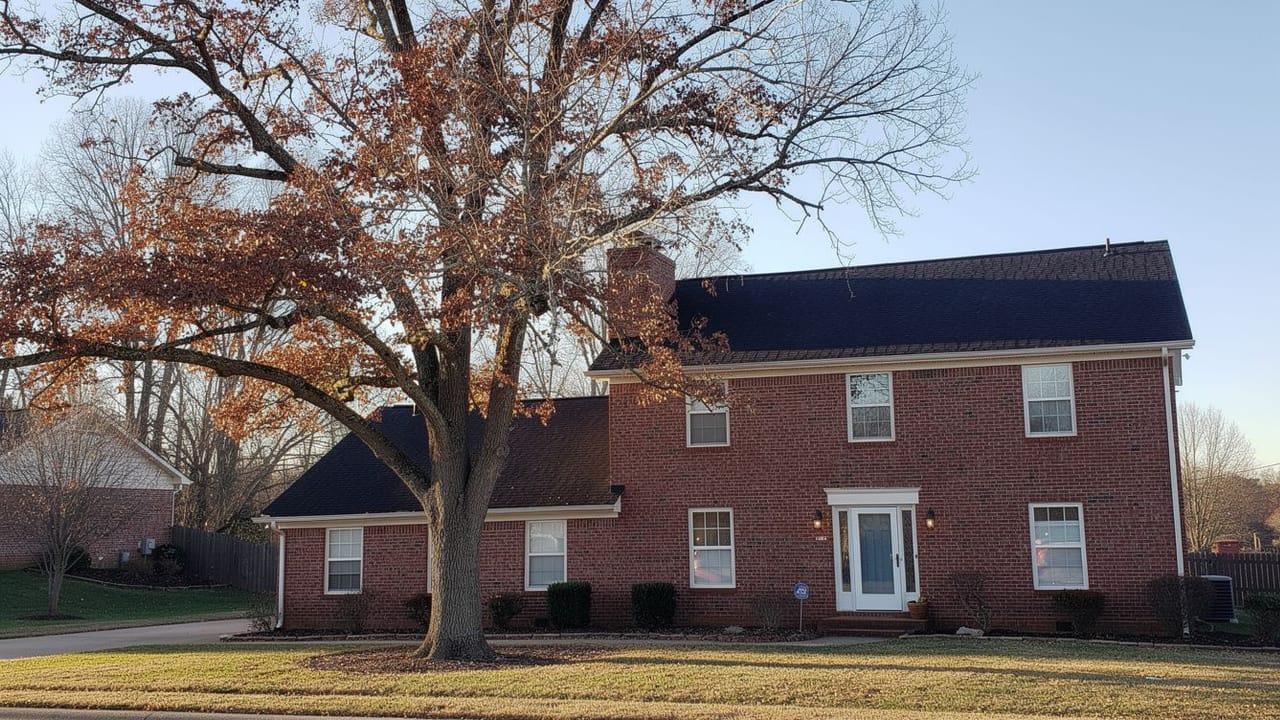
Limbs hanging over a roof bring most homeowners to the phone. They scrape the shingles in a storm, they fill the gutters every fall, and they look worse every time the wind picks up. The fix is to cut them back, but where those cuts go decides whether the tree grows back into the same spot within two seasons or stays clear for years.
Here is how far back a branch over a house should come, where each cut belongs, how much one visit can take, and how a limb above the roof gets down without landing on it.
How far should tree branches be from a roof?
No national rule sets a distance between branches and a roof. The ANSI A300 pruning standard, which applies to anyone who manages trees, treats it as clearance pruning and leaves the distance to the written specification for each tree. A University of Tennessee Extension summary of ANSI A300 Part 1 lists preventing interference with the built environment among the reasons to prune. It says a pruning specification should state the objective, the pruning system, the amount to remove and the types of cut.
So the clearance for your house is a judgment, and we write it down. We set it by how far the limb moves in wind, how much it sags in full leaf or under ice, and how fast that species grows. A limb that clears the roof in November can rest on it in July. If we cannot get a sound clearance without taking most of a limb, we say so before any cutting starts.
Where should a branch over the house be cut?
A branch over the house should be cut back to a side branch large enough to take over, not to a stub partway along the limb. The USDA Forest Service guide How to Prune Trees says that to prevent dieback, a reduction cut should be made at a lateral branch at least one-third the diameter of the stem at their union. Cutting between branches, which the guide calls topping or tipping, produces weakly attached sprouts, the opposite of what a limb over a roof needs, which is why we do not top trees.
The UT summary of A300 adds that the smallest cut that meets the objective is preferred, that most cuts on live branches should be in the outer part of the crown, and that a flush cut against the trunk is not acceptable. Where a whole limb has to come off, the final cut sits just outside the branch collar, the swollen ring where the limb meets the trunk.
How much of a tree can be pruned in one visit?
No more than about one-quarter of the living crown should come off in a single visit. The USDA guide sets that limit to avoid unnecessary stress and excess sprouting, and says that if more has to go, the work should be spread over successive years. It also warns against stripping the inner branches and leaving tufts at the ends, which it calls lion’s tails. The UT summary of A300 lists lion tailing as unacceptable.
That limit settles some jobs before we start. When a tree leans over the house and half its canopy sits above the roof, getting it clear in one visit would mean breaking the rule. The USDA guide calls crown reduction a method of last resort and says that removing a tree that has outgrown its space, and replacing it with one that will not, is often the better long-term answer. In that case we price both a plan spread over several years and a tree removal, and you choose.
How is a limb above a roof taken down?
A limb above a roof is cut in pieces and lowered on ropes, never dropped. The USDA guide describes the three-step cut used on any branch too heavy to hold with one hand. The first cut is a shallow notch on the underside, outside the branch collar. The second cut goes all the way through, a little farther out, leaving a short stub. The third cut removes the stub just outside the collar. Without the notch, the weight of the falling limb can strip bark down the trunk.
Over a house we add rigging. Each piece is tied off before it is cut and lowered clear of the shingles and gutters. Late fall and winter suit this work. The USDA guide recommends pruning hardwoods in the dormant season, when the structure is easy to see and fresh wounds are less likely to attract the beetles that spread oak wilt.
Our tree trimming page explains how we price the work. If you have limbs over the roof in Green Hills or nearby, ask us for an estimate and we will write down the clearance before we climb.
Sources
- University of Tennessee Extension, Pruning Trees and Woody Plants (summary of ANSI A300 Part 1) — Reasons to prune include preventing interference with the built environment; specifications state objectives, system, amount and cut types; smallest cut preferred; most live cuts in the outer crown; flush cuts, topping and lion tailing unacceptable
- USDA Forest Service, How to Prune Trees (NA-FR-01-95, revised 2012) — No more than one-quarter of the living crown at a time; reduction cuts to a lateral at least one-third the stem diameter; crown reduction a last resort; the three-step cut; topping, tipping, flush and stub cuts harm trees; prune hardwoods in the dormant season
FAQ
Tree Branches Over the Roof: How Far Back to Cut — questions
How much of a tree can be pruned at one time?
The USDA Forest Service guide How to Prune Trees says no more than one-quarter of the living crown should be removed at once, to avoid stress and excess sprouting. If a tree needs more taken off to clear a roof, the work should be spread over successive years, or removal should be considered.
Is a flush cut against the trunk bad for a tree?
Yes. The ANSI A300 pruning standard, as summarized by University of Tennessee Extension, does not accept flush cuts, and the USDA guide says they injure stem tissue and can lead to decay. The final cut belongs just outside the branch collar, the swollen ring where the limb joins the trunk, without leaving a stub.
What is a reduction cut on a tree branch?
A reduction cut shortens a limb by cutting it back to a side branch that can take over. The USDA guide says that side branch should be at least one-third the diameter of the stem being removed, to prevent dieback. It is the cut we use to pull a limb back from a roof.
When is the best time to cut branches back from a house?
For most hardwoods, late fall and winter. The USDA guide recommends pruning hardwoods in the dormant season, when the tree’s structure is easier to see and fresh wounds are less likely to attract the beetles that spread oak wilt. A limb that is cracked or resting on the roof should not wait.