
· by Michael Blair, Nashville's Tree Service
After a storm, the first hours go to safety, the utility, the photographs and the insurer, and our post on storm-damaged limbs covers that part. This one is about the decision that comes after: whether the tree in front of you has a future, or whether it should come down before it fails on its own. The guidance below comes from extension foresters, including the UT-TSU Extension office in Wilson County, which wrote it up after strong storms did heavy damage in the area, in a release dated March 8, 2020. It is the same reasoning our crews use when they walk a damaged tree for emergency storm work.
Can a tree that lost a big limb survive?
Usually, yes, when the break is in a branch rather than the trunk and most of the crown is left. The UT-TSU Extension Wilson County release on storm damage to trees (March 8, 2020) ranks a branch broken away from the main stem as the least damaging kind of storm injury. It says broken branches generally do not decide whether the tree lives unless more than half the crown is involved, and that the higher the break and the smaller the wood at the break, the better the odds.
The University of Missouri Extension guide to storm-damaged trees, first published in September 2017 and reviewed in August 2025, gives the rule of thumb most foresters start from: is at least half the crown still intact? A tree with less than half its branches left may not grow enough leaves to feed itself through the next season. The same guide says a mature shade tree can usually survive losing one major limb, with the broken branch pruned back to the trunk and the wound watched for decay in the months after.
Iowa State University Extension lands in the same place: a tree with a few broken side branches, or minor damage to the trunk or crown, can be saved if it is pruned properly.
When does a split trunk mean removal?
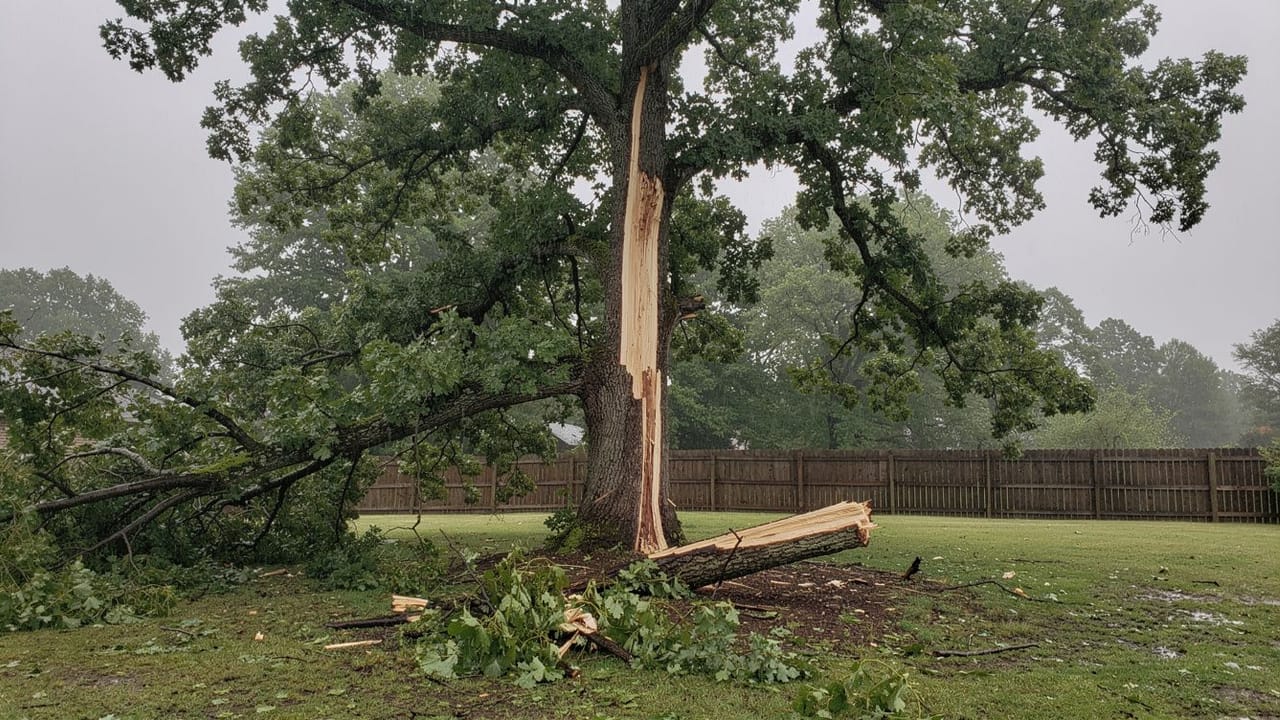
Almost always. Iowa State Extension says a tree with a split trunk or extensive trunk damage is no longer structurally sound and should be removed, along with large trees that have lost half their canopy or more and trees left leaning and partly uprooted. MU Extension puts a split trunk in the same group as a tree already weakened by disease or one missing more than half its crown: each has lost its survival edge. Its guide traces many split trunks to a rotten core or a weak branch union that was there before the storm.
The Wilson County release explains why repairs rarely change that. Trees do not heal a wound; they grow over it and wall it off, and that wood stays weaker than sound wood. Once more than 30 to 50 percent of the main branches or the trunk is badly split or broken, it calls extensive repairs questionable, and it notes that larger, mature trees are the ones most likely to suffer this kind of break. A split that runs down into the trunk of a big tree near the house is the case where we recommend removal rather than repairs and hope.
Bent young trees and missing leaders
Young trees recover from a lot, with limits. The Wilson County release says a young tree bent near or past horizontal will probably not recover and should be replaced, and that staking a bent tree back up gives mixed results. MU Extension adds that a young tree with its leader intact and its branching structure in place can sustain heavy damage and still come back.
The leader, the main upward stem, is the deciding part. MU Extension calls its loss a judgment call: the tree may live, but at best as a stunted or misshapen version of what it was. The same guide raises one more question worth asking of any damaged tree, which is whether it is in the right place at all. A badly damaged tree that is also growing toward a power line, or is a species you never wanted, may be better replaced than nursed.
Which storm damage can wait, and which cannot?
Anything hanging, split or leaning over the house, the drive, a line or a play area cannot wait; a tree that is standing with most of its crown can wait for a calm decision. MU Extension’s advice is that when a damaged tree poses no immediate physical risk and you are unsure of its condition, keep it for now, prune the broken branches carefully, and decide later. It also warns against pruning too hard, since the tree needs every leaf it has left for the next season, and it recommends a professional arborist for large trees in borderline cases.
Broken branches still need attention soon. The Wilson County release says they should be dealt with quickly so they do not become a hazard and to limit the decay organisms that enter through the wound, and that cuts go back to the trunk or a main limb just outside the branch collar, never flush. It also says to skip wound dressings: paint, tar and similar products do not prevent decay and can slow the tree’s own sealing.
This is also the part not to do with a borrowed saw. Both extension sources warn that broken and bent limbs are often under tension and can kick back without warning when cut, and MU Extension says bent trees and branches over 6 inches across should be left to someone with more experience.
If a tree is already showing the signs in our post on a tree about to come down, call that day; for anything else, our crews walk damaged trees in Franklin, Nashville and across Middle Tennessee, and a tree that may be saved gets a plan through our tree health care work. Send us photos and a description and we will tell you which group yours falls in.
Sources
- UT-TSU Extension, Wilson County, Storm Damage to Trees: Assessment and Care (release, March 8, 2020) — Repairs questionable when more than 30 to 50 percent of main branches or trunk are severely split or broken; survival poor after losing more than 50 percent of the crown; young trees bent near or past horizontal should be replaced; broken branches away from the stem least damaging; cut outside the collar; limbs under tension can kick back; wound dressings do not prevent decay.
- University of Missouri Extension, G6867, First Aid for Storm-Damaged Trees (September 2017, reviewed August 2025) — At least 50 percent of the crown intact as the rule of thumb; a mature shade tree can usually survive losing one major limb; split trunk, disease or more than half the crown gone means the tree has lost its survival edge; leader loss a judgment call; keep the tree for now if unsure and not hazardous; bent trees and branches over 6 inches to experienced hands.
- Iowa State University Extension and Outreach, How can I determine if damaged tree can be saved? — Split trunks or extensive trunk damage: remove; large trees with 50 percent or more of the canopy lost, or leaning and partially uprooted: remove; a few broken side branches can be saved with proper pruning.
FAQ
Storm-Damaged Tree: Save It or Take It Down — questions
Can a storm-damaged tree be saved?
Often, yes. A tree with a sound trunk, at least half its crown left and only side branches broken usually recovers with proper pruning, according to Iowa State and MU Extension. A split trunk, more than half the crown gone, or a tree leaning with its roots partly out of the ground generally means removal.
How much of a tree can break off before it dies?
The usual line is half the crown. UT-TSU Extension in Wilson County says survival odds are poor once a tree loses more than 50 percent of its crown, and MU Extension asks whether at least half is still intact. Below that, the tree may not grow enough leaves to feed itself through the next season.
Does a tree with a split trunk have to come down?
In most cases. Iowa State Extension says a split or extensively damaged trunk leaves a tree structurally unsound and it should be removed, and MU Extension says a split trunk costs the tree its survival edge. Trees wall off wounds rather than heal them, so the split stays a weak point.
Should you put paint or tar on a broken tree limb?
No. The UT-TSU Extension office in Wilson County says research shows wound dressings such as paint and tar do not prevent decay and can interfere with the tree sealing over the wound, and some can feed harmful microorganisms. A clean cut just outside the branch collar is what helps the tree.
Will a young tree bent over by a storm straighten up?
It depends on how far it went and for how long. UT-TSU Extension says young trees bent near or past horizontal will probably not recover and should be replaced, and that staking gives mixed results. A young tree bent less, with its leader intact, has a fair chance of coming back.