
· by Michael Blair, Nashville's Tree Service
Once a tree is down, the stump is its own decision. It can be ground out, left to rot, treated with a stump remover or, if it is small, dug out by hand. Each one leaves something different behind: a hole full of shavings, a stump that sits in the yard for years, or chemicals in the soil that do less than the label suggests. Here is what each method actually does, using university extension guidance, and what to expect from the spot afterward. The machine work is our stump grinding service.
How deep does stump grinding go, and does it take the roots?
Stump grinding typically goes 8 to 12 inches below the ground and takes the stump along with its large side roots, but not the whole root system. Iowa State University Extension’s guide to removing tree stumps, reviewed in April 2025, gives that depth range for the stump and the large lateral roots. A 2014 post from the University of Illinois Extension on removing tree stumps describes a grinder chipping a stump out to about the same depth in minutes.
Roots past that depth and beyond the main laterals stay in the ground. Iowa State also notes how the work is usually priced: by the stump’s width at its widest point, with the shavings left in the hole unless you ask for them to be hauled off, and filling the hole charged as an extra. We tell you which of those is in the quote before the grinder starts. Because the wheel works below grade, the utility locate request comes first; our post on Davidson County’s tree rules explains how that works.
What happens to the wood chips after a stump is ground?
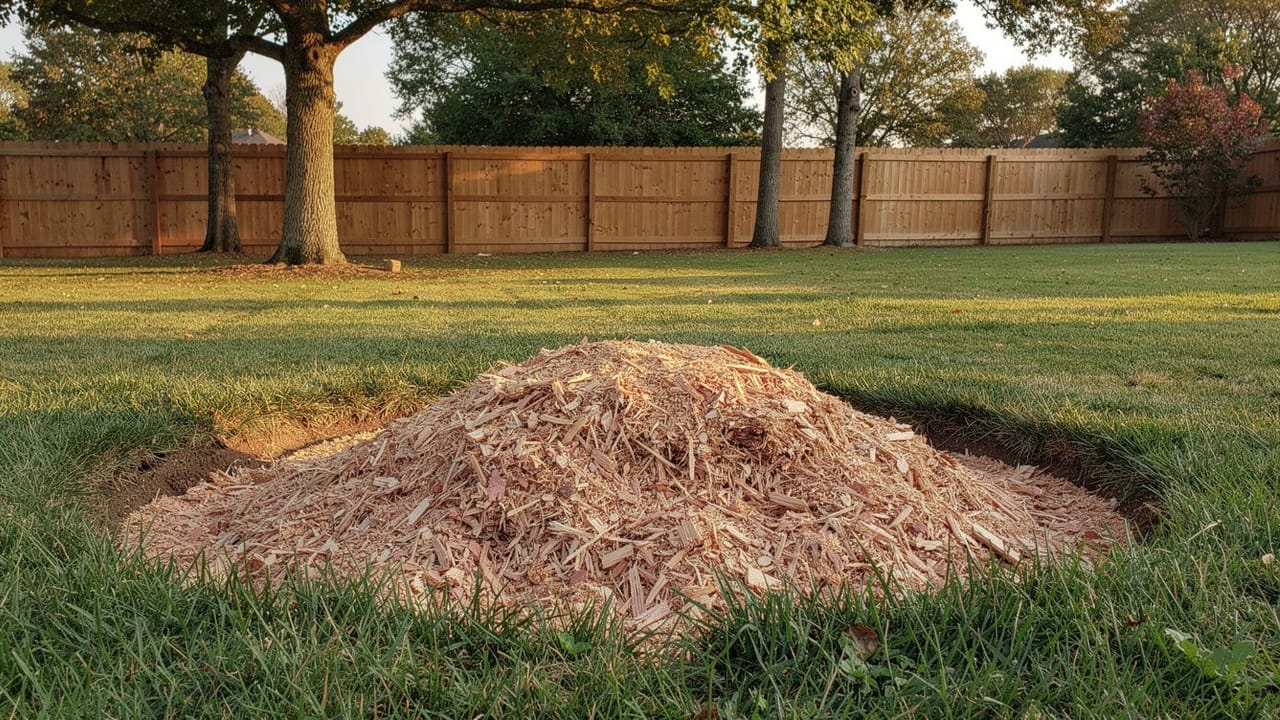
The wood chips from a ground stump usually stay in the hole, and left there they work against anything you plant. Iowa State explains that the shavings change the soil’s structure, how it holds water and its balance of nutrients, which makes it hard for new turf or other plants to establish. Its advice is to take the shavings out before topsoil goes in and the spot is replanted.
Removed shavings are not waste. Iowa State says they can be composted or taken to a municipal composting site. If you want grass or a new tree where the stump was, tell us when you book, and we will clear the shavings and leave a hole ready for topsoil rather than a mound of chips. If you want a tree there again, our list of trees worth planting in a Nashville yard is a place to start.
Can you leave a stump to rot instead?
You can leave a stump to rot, but on its own it can take ten years or more, by Iowa State’s estimate. The same guide gives a way to speed it up: drill holes about an inch wide, no more than a foot apart and at least ten inches deep, and put around four ounces of slow-release fertilizer in each. After one to three years the stump can usually be broken apart with a sharp spade.
Commercial stump removers work along the same line. Iowa State says they are often potassium or sodium nitrate, and the Illinois post describes drilling holes, adding the measured chemical and water, and waiting four to six weeks, with repeat treatments sometimes needed. Iowa State adds that herbicide poured into holes or over a stump does not speed decay and only soaks into the soil. Burning is a poor shortcut: stump fires can smolder for days and, it notes, many cities and counties ban burning. Digging out by hand suits stumps under about a foot across, and pulling with a chain carries real risk if it slips or snaps.
Does grinding a stump stop the sprouts?
Grinding a stump does not always stop the sprouts, because some trees send up new shoots from the roots left in the ground. Iowa State’s method for sprouting trees is herbicide, glyphosate, triclopyr or imazapyr, applied to the living ring of tissue just inside the bark on the fresh cut, then cutting each new sprout and treating again until they stop. It also says to steer clear of picloram, sold as Tordon. The Illinois post says to treat the cut surface right after the tree comes down, or to keep cutting suckers before they reach eight inches, which can take five to ten years to work.
Callery pear, the tree sold as Bradford pear, is one that comes back from its stump and roots, and our post on Bradford pears covers that tree in full. We grind sprouting stumps in Brentwood, Franklin and across Middle Tennessee; if a stump keeps coming back or you want one gone before replanting, ask us for a free estimate.
Sources
- Iowa State University Extension and Outreach, How to Remove Tree Stumps (reviewed April 2025) — Grinding typically 8 to 12 inches deep with large lateral roots; priced by width; shavings left unless removed and their effect on new turf; composting; natural decay 10+ years and the drilled-hole fertilizer method; nitrate stump removers; herbicide on the cambium for sprouts, avoid picloram; burning prohibited in many places; digging small stumps.
- University of Illinois Extension, Removing Tree Stumps (Rhonda Ferree, June 20, 2014) — Grinding 8 or 12 inches below grade; chemical removers stand four to six weeks and may need repeating; treat the cut surface or cut suckers before eight inches, five to ten years; a hot fire is required.
FAQ
Stump Grinding, Rotting or Remover: What Each Does — questions
Does stump grinding remove the roots?
Only the stump and its large side roots, typically to 8 to 12 inches below ground, according to Iowa State University Extension. Deeper roots and smaller ones farther out stay in the soil. Some trees can still send up sprouts from the roots that remain, which takes herbicide on the fresh cut and repeated cutting to stop.
How long does a tree stump take to rot?
Ten years or more if it is left alone, by Iowa State University Extension’s estimate. Drilling inch-wide holes about a foot apart and at least ten inches deep, with slow-release fertilizer in each, speeds it up so the stump can usually be broken apart with a spade after one to three years.
Does stump remover actually work?
Slowly. Most stump removers are potassium or sodium nitrate; the University of Illinois Extension describes drilling holes, adding the chemical and water, and waiting four to six weeks, sometimes repeating. Iowa State notes that herbicide poured into a stump only leaches into the soil and does not speed decay. Grinding is much faster.
Can you plant grass right after stump grinding?
Not well into the shavings. Iowa State University Extension says they change the soil’s structure, water-holding and nutrients enough to make new turf hard to grow. Remove the shavings, fill with topsoil and seed or sod after that. Ask the crew to haul the shavings off, since they stay in the hole by default.
Should I burn a tree stump?
Usually not. Iowa State University Extension warns that stump fires can burn for days and that many cities and counties prohibit burning, and the University of Illinois Extension notes it takes a hot fire. Check your local rules first; grinding or a drilled-and-fertilized stump left to rot avoids the fire risk.