
· Michael Blair
Topping is cutting the main limbs of a tree back to stubs to reduce its height, usually because it has grown taller than someone is comfortable with. It is quick, it is cheap, and every arborist trade body condemns it, because a topped tree is less safe than the one it replaced. Crape myrtles get it every winter along Nashville streets; shade trees get it when a storm has made someone nervous.
What happens after the cut
A tree stores energy in its wood and its roots in proportion to its leaf area. Removing the top removes much of that leaf area at once, and the tree responds by pushing out a mass of fast-growing shoots from dormant buds just below each cut. Within a few seasons the tree is back to its old height, but that height is now carried on a thicket of weakly attached shoots rather than on the original limbs.
The stubs themselves cannot heal. A cut made at a proper branch collar is sealed by the tree; a cut in the middle of a limb is not, and the exposed wood decays down into the limb. Ten years after topping, the tree is a set of rotting stubs each carrying a bundle of heavy shoots attached only to the outer layer of wood.
Why it makes the tree more dangerous
The sprouts that follow topping are joined to the tree at the surface, not anchored in the wood the way a natural limb is, and they grow long and dense. In a Middle Tennessee ice storm or a summer wind event they tear out in a way an original limb would not. Topping to reduce the risk of a limb falling on the house produces, a decade later, a tree that drops far more of them.
The sudden loss of canopy also sunburns the bark on limbs that were shaded, invites borers and canker into the wounds, and can kill a stressed or older tree outright. A large oak or maple that is topped is often a tree that will need removing within fifteen years.
- Regrowth is fast, dense and weakly attached
- Stub cuts decay rather than seal
- Sunscald and borer damage on newly exposed bark
- Higher failure risk in wind and ice, not lower
What to ask for instead
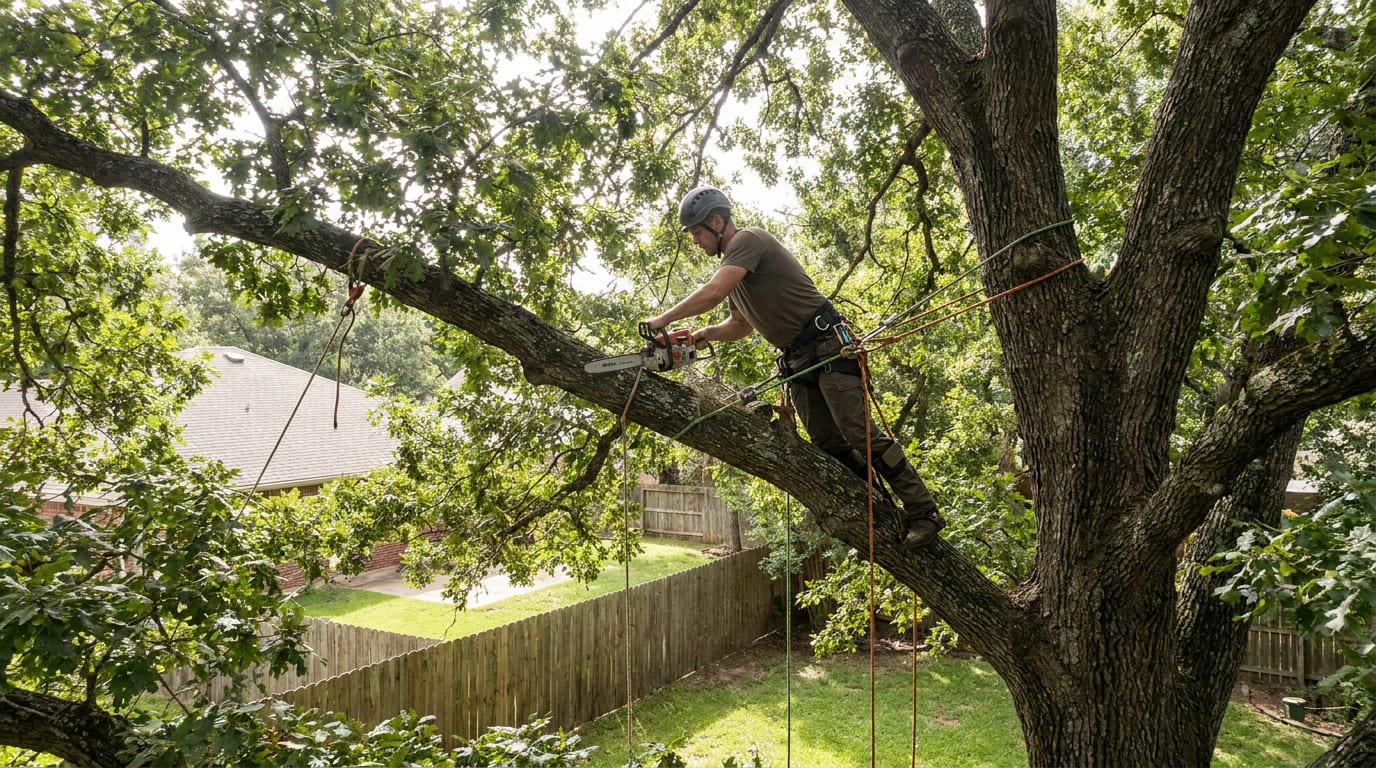
Crown reduction is the proper way to make a tree smaller. Limbs are cut back to a lateral branch that is large enough to take over as the new end, so the tree keeps a natural shape, the cuts are at points that can seal, and regrowth is moderate. It takes more skill and more time, and it cannot make a tree as short as topping can, because there are limits to how much can be removed in one go.
Where a tree is genuinely too big for its position, over the house, into the service drop, on top of the sewer line, the honest choices are reduction within what the tree tolerates, or removal and replacement with a species that fits. Topping is the option that looks like a compromise and delivers the worst of both.
Crape myrtles, specifically
The annual cutting of crape myrtles to knuckles is so common here it has a nickname. It produces the same result as topping any other tree: a knot of stubs, a flush of thin whip growth each summer, and flower clusters too heavy for the shoots that carry them, so they droop and break in the first storm. The trees survive it because crape myrtles are tough, not because it is good for them.
A crape myrtle needs almost no pruning beyond removing suckers, crossing branches and seed heads if wanted. If the variety is too large for where it was planted, the fix is a smaller variety, not an annual amputation.