
· by Michael Blair, Nashville's Tree Service
A driveway slab that rises a little more every year almost always has a root under it. The question we hear is whether the root can come out without hurting the tree. Sometimes it can. Sometimes the cut would sit so close to the trunk that the tree is weaker in the next storm, and then the driveway, not the root, is the part to change.
Here is why roots lift pavement, how close to the trunk a cut can go, how it should be made, and what else can be done.
Why do tree roots lift a driveway?
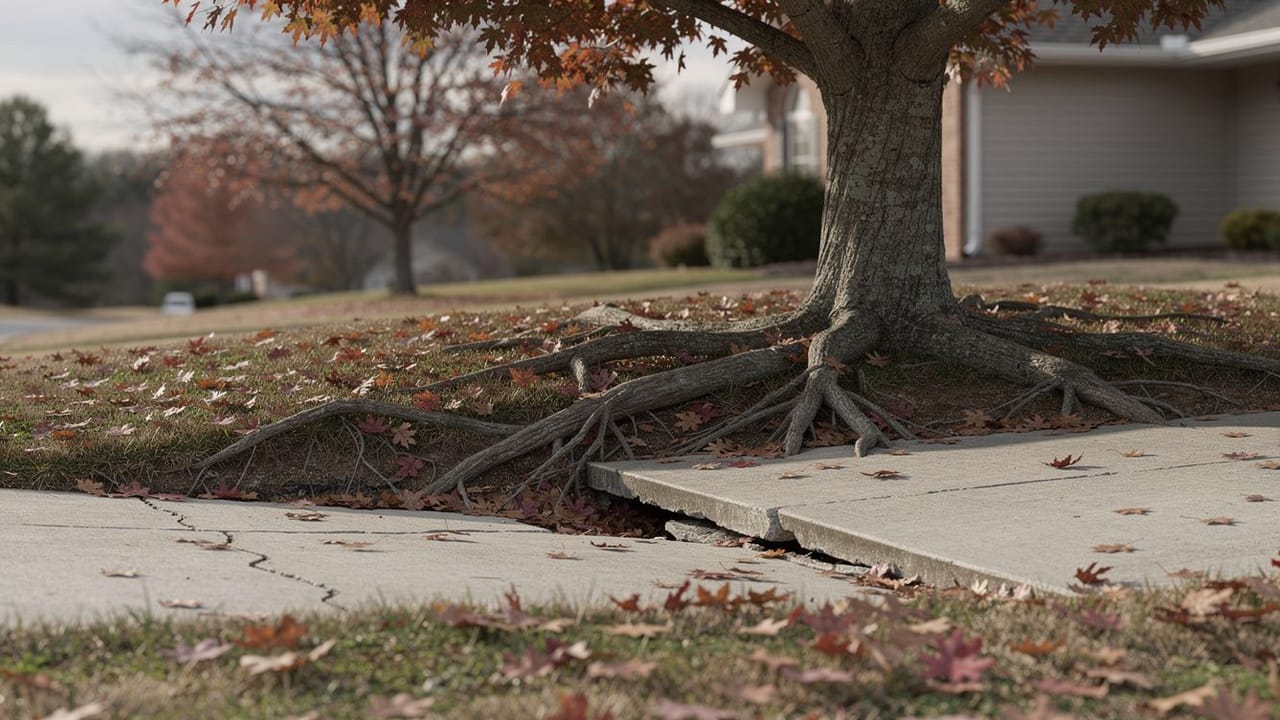
Tree roots lift a driveway because they grow in thickness every year, the way a trunk does, and a slab sitting on top of a root has nowhere to go but up. Iowa State University Extension’s guide to trees near sidewalks explains that roots spread sideways near the surface looking for water and nutrients, often run under paving, and then push against it as they widen.
Most of a tree’s roots are shallow. Purdue’s consumer horticulture page on surface roots puts the usual depth at four to eight inches and notes that compacted, poorly drained soil keeps them even shallower. That describes a lot of Middle Tennessee yards: heavy clay, packed down during construction, with a concrete drive poured a few feet from a shade tree that has since doubled in size.
Can you cut tree roots without killing the tree?
You can cut some tree roots without killing the tree if the cut is far enough from the trunk and the root is not too large. Iowa State says not to cut buttress roots closer than three times the trunk diameter, measured three feet above the ground, and to avoid roots larger than two inches across. At one and a half times the diameter or closer, it says removing the tree is the more prudent choice, because cuts that close invite crown dieback and wind failure.
The Bartlett Tree Research Laboratories technical report on root pruning sets a preferred minimum of five to six times the trunk diameter, which for a 12-inch tree is five to six feet. Cutting on one side only can come in to three times the diameter, three feet for that same tree. The report says even that is too close if the other side of the root system is already under pavement, or if the tree is leaning or has root decay.
That last condition matters for driveways. A tree between a driveway and a street or walk often has paving on two sides already, so we measure before we promise anything.
How should a root under a driveway be cut?
A root under a driveway should be uncovered first and then cut cleanly with a saw or loppers, never torn out with a trencher or excavator. The Bartlett report calls a trencher one of the worst ways to cut roots, because it lifts surface roots until they snap and crushes others. Uncovering the root by hand, or with air or water, lets the arborist choose where to cut, ideally beyond a junction.
The report also covers aftercare. Roots should not be cut just before or during a dry spell unless the tree will be watered, and water should go on before and after the cut if rain does not. Mulch over the root zone holds moisture and helps new roots grow.
We do this as part of our tree health work: measure the trunk, mark the minimum distance, expose the root, and decide on the spot whether a cut there is sound. If it is not, we tell you before the saw comes out.
What can be done besides cutting the root?
Besides cutting the root, the paving itself can be changed. Iowa State lists grinding the raised edge level, which it describes as temporary because the root keeps growing, and patching the low side so the edge disappears. A longer fix is replacing the lifted section with one that rises over the root on a thicker base, with at least four inches of gravel or foam board underneath to send roots deeper.
Root barriers are the option people ask about most. Iowa State says they need to be at least 18 inches deep with the top above the soil and mulch, and Purdue warns that most barriers eventually fail as roots go over or under them. Purdue also says cutting visible roots is likely to cause serious damage over time and should be a last resort.
When a tree is in poor shape or simply too close, removing it and planting a smaller species farther from the drive can be the better answer. Our post on tree roots, foundations and sewer lines covers what roots do near a house. If a driveway is lifting in Brentwood or nearby, ask us to look at it and we will measure before recommending a cut.
Sources
- Iowa State University Extension and Outreach, How to Manage Trees Near Sidewalks — Why roots lift pavement; root cuts no closer than three times trunk diameter, avoid roots over 2 inches; barriers 18 inches deep; four-inch root-excluding base; grinding, patching and bridging.
- Bartlett Tree Research Laboratories, Root Pruning (technical report, Fite and Smiley) — Preferred minimum cut distance five to six times DBH, three times for one side; too close with pavement, decay or lean; trenchers tear roots; watering and mulch after.
- Purdue University Consumer Horticulture, When Tree Roots Surface — Most roots four to eight inches deep; compaction keeps them shallow; cutting visible roots likely to cause serious damage; most root barriers eventually fail.
FAQ
Tree Roots Lifting the Driveway: What Can Be Cut — questions
How close to the trunk can tree roots be cut?
Iowa State Extension sets the minimum at three times the trunk diameter, measured three feet above the ground. Bartlett’s research lab prefers five to six times for cuts on several sides and three times for one side, but calls even three times too close if the tree leans, has root decay or has paving on its other side.
Will a tree fall over if its roots are cut?
It can if the cuts are too close to the trunk or remove too much. Iowa State warns that cutting buttress roots inside three times the trunk diameter raises the risk of crown dieback and wind failure, and that at one and a half times or closer, taking the tree down is usually the more prudent choice.
Do root barriers stop roots from lifting concrete?
They can slow it, but they are not permanent. Iowa State says a barrier must be at least 18 inches deep with its top above the soil and mulch to work at all. Purdue notes that most barriers fail over time, as roots grow under or over them or the barrier cracks.
Can you pave over tree roots?
Yes, if the new paving is built for it. Iowa State describes replacing a lifted section with one that slopes up over the roots, set on a thicker base or piers, with at least four inches of gravel or a foam-board base beneath to steer roots deeper rather than straight back into the slab.